
Family Violence is:
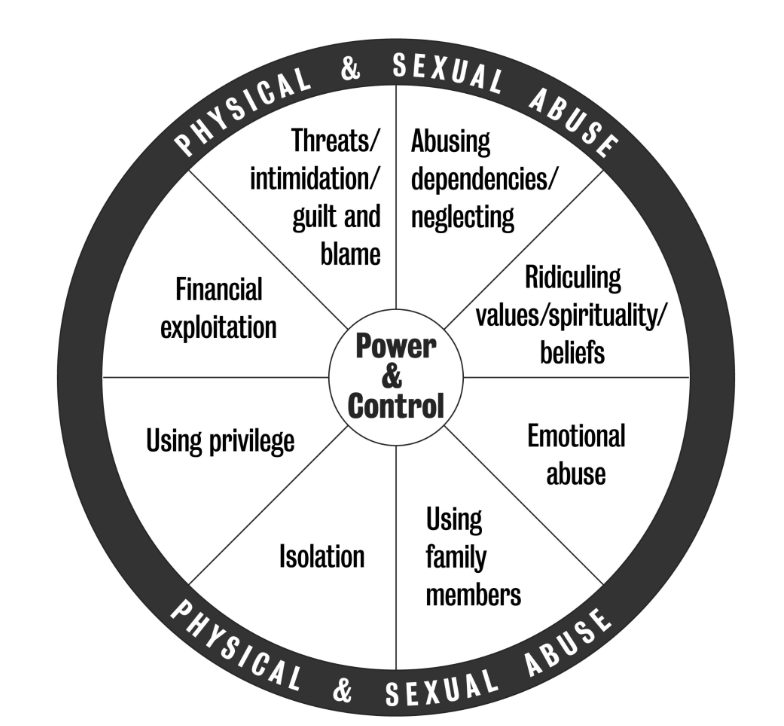
The Power and Control wheel is a diagram that illustrates the various tactics (many non-physical) that a person causing harm or using violence uses to dominate their victim in a relationship. The inside of the wheel highlights various types of tactics a person causing harm or using violence may use to achieve Power & Control over the survivor. Even the threat of the physical/sexual violence can be enough to make the other tactics more “effective” in dominating/controlling the victim/survivor.
The traditional “Power and Control Wheel” was first created by the Duluth Project, MN in the 1980s and has been popularly used ever since. The wheel is a tool that helps make the pattern, intent, and impact of violence visible.
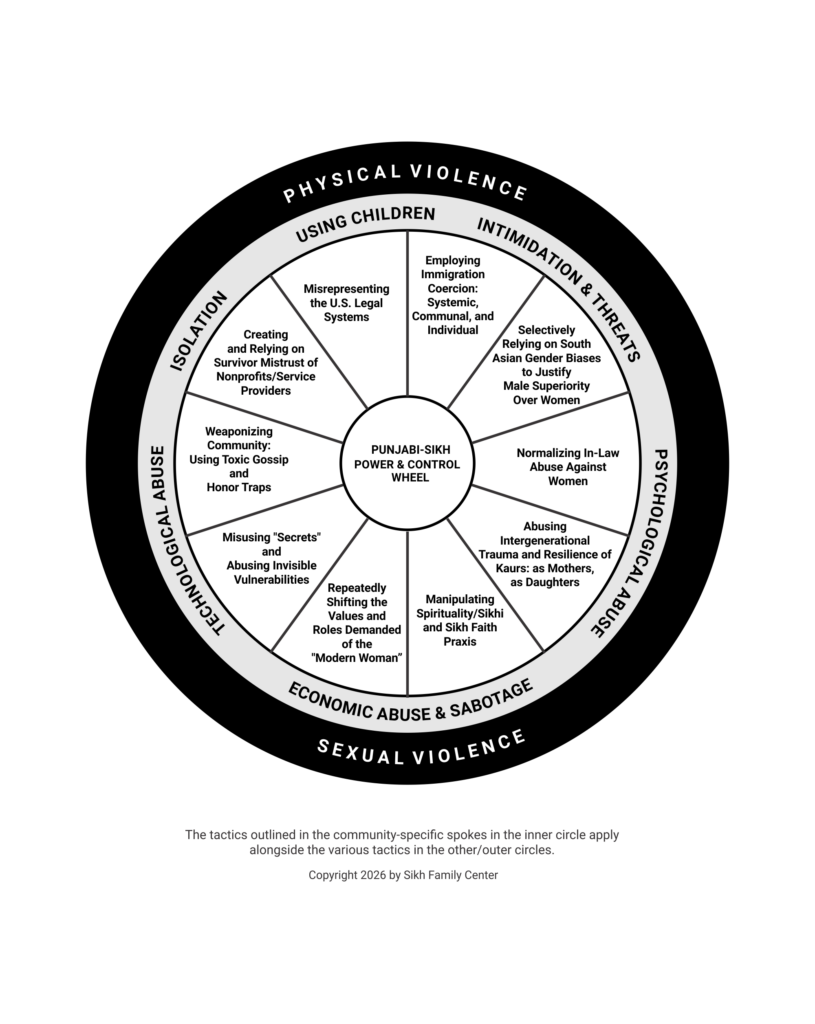
Notes regarding the Punjabi Sikh Power and Control Wheel:
This Wheel focuses on Punjabi Sikh women survivors in the U.S.
“Punjabi Sikh” refers to a unique cultural community, a people connected by ancestry in the Sikh faith and the geographic region of Punjab, South Asia. While Sikhs today live in various parts of India, South Asia, and the U.S., the majority find their ethnic ancestors—including Sikh Gurus–in Punjab and Punjabi culture.
The wheel was co-created by survivors—those who self-identified as female as well as Punjabi Sikh—who provided input through anonymous surveys as well as listening circles convened by Sikh Family Center. It also draws from the wisdom of various survivor-organizers at Sikh Family Center, the community-based organization that has served hundreds of Punjabi Sikh survivors since 2009.
The Circles:
The outer circle represents the physical and sexual violence that ‘holds’ the power and control in place. The inner circle represents various tools of abuse that are common, across various cultures, to various abusive relationships, even though their specific manifestations are unique to each situation. The inner-most spokes of the wheel are the various culturally-determined tactics employed by those who abuse within the Punjabi Sikh community. These tactics, detailed below, necessarily operate in the context of the two outer circles. Altogether, the various compounding tactics result in creating and maintaining power and control over the victim—the core of the wheel—that denies the victim health, safety, and self determination.
A Caution:
While violence exists and proliferates when there are few resources for survivors, there is also resistance and strength in the collectivist Punjabi Sikh culture. Most survivors we serve would never wish to see the community painted only as victimizing and themselves as only “victim,” as Sikh Family Center regularly highlights.
The Danger Assessment is a risk evaluation tool, originally developed by Jacquelyn Campbell (1986), that is designed to determine the likelihood of severe or lethal harm in intimate partner relationships.
Sikh Family Center adapted the Danger Assessment tool for Sikh Women to reflect the community’s nuances and lived realities. It is not just a literal translation of the original assessment.
We have retained the statistically significant factors the peer counselors on our Helpline have been trained to identify by John Hopkins School of Nursing, the pioneers of the DV Danger Assessment.
But we have also incorporated our community-specific dynamics, especially to ease the more individualistic elements (for example, absence of in-law abuse, or community intervention possibilities) of the existing tools.
As a people, we must do better identifying and strengthening every high-risk survivor, facing interlocking vulnerabilities.
Factors on the Danger Assessment are not all equally weighted: that is, of many factors that contribute to heightened danger and lethality, research shows that some are especially dangerous.
Of these especially dangerous factors, some are more obvious to the general public (for example, the existence of a firearm) while others (for example, unemployment, past non-fatal strangulation, marital rape, or the absence of children from the home) are not as intuitive. Similarly, post-separation violence – that is, violence that follows and even exacerbates after the victim completes the already daunting task of separating from the abusive partner – is often dangerously underestimated.
The Danger Assessment is only one step towards safety planning and survivor empowerment. There is no one formula.
Each survivor must be connected with trained, private, reliable advocates with whom they can privately discuss their safety concerns, priorities, and strategies. Sometimes the advocates are within their own community, sometimes far outside it – the survivor should be able to choose.
We encourage anyone who has concerns or questions to reach out to our Helpline. You can complete the questionnaire at your own pace and discuss the results with a trained advocate later.
You are not alone. You have the right to safety. You have options.
“I think physical is obviously up there; but I also think mental, emotional, I think doing gaslighting for example, I consider that to be violence as well because over a period of time it breaks somebody’s mental status down; but certainly emotional – somebody who’s constantly attacking you emotionally, or if you’re walking on eggshells around them I call that violence as well…”
“Gaslighting I believe comes from this (1940s) Ingrid Bergman movie. There the plot was… there is a husband and wife living in a house and he was doing an experiment or something in the basement which he (husband) did not want her (wife) to know about. But every time he did it, the lights in the house went dim and big, like they went on and off, on and off, and every time she told him about it, he told her that she’s imagining it. So eventually he convinces her that she’s imagining it and she has lost her mental balance, so that’s gaslighting – where somebody challenges your reality, the way it is to such an extent that you completely lose your sense of self and you cannot identify any longer what is normal, what’s not. If this person even hits you, even that you end up justifying because that just becomes your reality. You have been gaslighted into a new set of reality. I consider that to be a violence too.”